
MAF explored: can running slower help me run faster?

AI-generated illustration of a male runner from behind on a single treadmill in a worn gym corner.

Can running slower help me run faster? With Chester behind me and roughly ten weeks before my next marathon training block, I have a useful opportunity to explore MAF training—and put myself through a small experiment.

MAF stands for Maximum Aerobic Function. Developed by Dr Phil Maffetone, the approach uses a heart-rate ceiling to keep training easy while building aerobic endurance and the capacity to use fat as fuel. The aim is to become faster at the same comfortable effort.

The familiar calculation is 180 minus your age, with adjustments for health and training history. At 49, that gives me 131 bpm before adjustments. Recent illness and interrupted training suggest a more cautious starting point of 126 bpm under Maffetone’s rules.

There is good science behind the benefits of easy endurance training. There is less certainty that this particular calculation identifies an individual’s aerobic threshold accurately. I’m treating it as a practical starting point, with an open mind about what the results will show.

My initial treadmill test is planned for Monday 19 October, provided I have recovered sufficiently from the marathon. I’ll then repeat the same test each Monday morning: the same fixed distance, the same target heart rate, and as consistent a set-up as possible, including the treadmill, incline, warm-up and cooling.

My Garmin does not accurately measure my treadmill pace, so I’ll calculate pace from the elapsed time taken to cover the fixed distance shown on the treadmill. I’ll use the watch to record heart rate, rather than letting its distance estimate decide whether I’m improving.

The question is simple: will I cover that distance more quickly at the same heart rate? I’ll also note how I feel and how well I recover. Early gains may reflect recovery from Chester and the recent illness, so I’ll look at the trend rather than celebrate every quicker test.

I’ll add the results here as the weeks unfold. Ten weeks, one willing guinea pig, and a little patience.

Further reading: Maffetone’s 180 formula and research on endurance-training adaptations.

Week 40: 28 September – 4 October

A quiet leaf-covered path beneath autumn trees, with countryside beyond.

Run: 2h 10m (14.8 miles) | Cross Train: 0h 33m | Gym: 0h 00m

This was a cautious week of getting back into a regular routine. The running total was modest, but after a disrupted spell it was good simply to string some easy runs together again without feeling any need to chase the mileage.

The runs were all kept easy and deliberately low-key. Heart rate was still higher than it should normally be for the pace and effort, although that is probably to be expected while getting back to normal after illness and time away from running. For now, simply being able to run comfortably again feels more useful than turning every outing into a fitness test.

I also had my regular half an hour in the pool with my swim coach. Swimming at the moment is almost entirely technique-focused, so the clock is fairly irrelevant. The work is still about slowing the stroke down, improving the breathing and trying to make the whole thing feel a little less hurried.

Next week’s focus is on getting the legs moving normally again. I’ll introduce a little faster running or tempo work if everything continues to settle, but only in small doses. There is no fitness to be gained by suddenly trying to squeeze missed sessions into the final few days. With Chester Marathon now very close, arriving healthy matters rather more than trying to rescue the training block at the last minute.

Beyond Chester, I’m actually looking forward to taking the pressure off for a while. Autumn is probably my favourite time to run, so there should be a few weeks of easy running simply because I fancy going out, rather than because a training plan says I should. I’m particularly looking forward to a trip to the Lake District after the marathon — hopefully with no pace targets, no tempo miles and considerably more interest in the scenery.

Week 39: 21–27 September

Run: 0h 27m (2.5 miles) | Cross Train: 0h 33m | Gym: 0h 00m

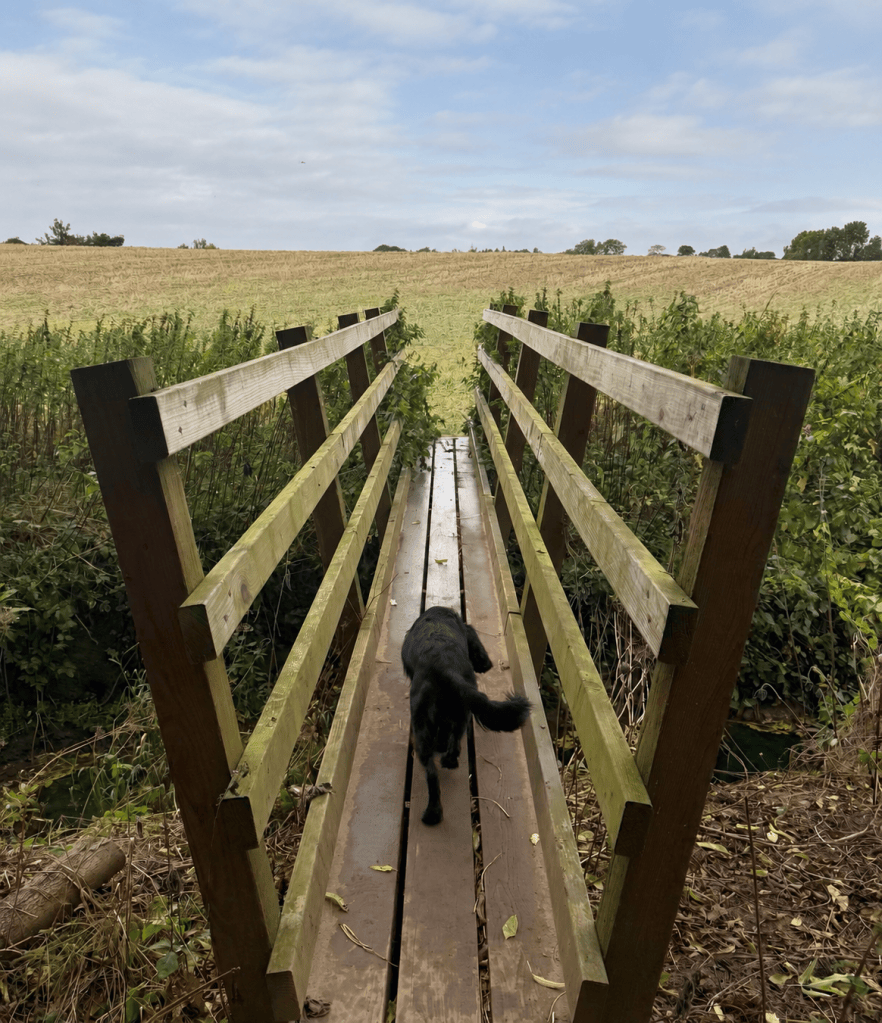
Black cocker spaniel crossing a wooden footbridge beside a field under a lightly blue overcast sky.

Exercise this week has been almost entirely dog-walking, whilst waiting for the cough to clear and trying not to make a bad situation worse.

By Friday I was still coughing, although less than earlier in the week, and still hadn’t managed a test run. With Chester getting very close, I’ve more or less accepted that it is no longer going to be the sub-three-hour attempt I had been training towards. That’s frustrating after putting together a decent block through the summer, but there isn’t much point pretending the last couple of weeks haven’t happened.

The thinking now is that Chester may end up being an extended easy run rather than a race. If I get there feeling reasonably healthy, one option is to run the first half very conservatively and then pick things up if everything feels good. More importantly, everything from here starts to feed into London in April. There is probably more value in arriving at that training block healthy than trying to rescue a marathon performance from a fortnight disrupted by illness.

I did at least get back in the pool this week. I’m still rushing the stroke, particularly on the left side, and struggling to get enough air in. The focus is on keeping my head flatter in the water and rotating sideways rather than lifting it to breathe, with a little more rotation to get my mouth properly clear. It remains one of those things that sounds very straightforward when somebody explains it from the side of the pool.

Sunday finally brought a very tentative 2.5-mile test run. There was no headache, nausea or anything concerning in the chest, which was encouraging. My throat is still noticeable painful when swallowing, though, and the hamstrings felt surprisingly tight after the lay-off. Heart rate was also much higher than I would normally expect for the pace, although after nearly two weeks without running while fighting off a virus that probably isn’t especially surprising.

So, 2.5 miles is hardly the triumphant return I might have imagined at this point in a marathon plan, but at least it is a start. I’ll try another short and easy run tomorrow and see whether the heart rate and general feel begin to settle. There is certainly no mileage to be made up now.

Week 38: 14 – 20 September

Run: 0h 00m (0.0 miles) | Cross Train: 0h 34m | Gym: 0h 00m

There are weeks when the training plan dictates what happens, and there are weeks when your body makes the decision for you. This was very definitely one of the latter.

I came into Monday with sore quads from the Great North Run and was quite happy to take a complete rest day, other than walking the dog. After that, though, what should have been a straightforward few days of post-race recovery turned into something rather different.

By Tuesday a bad throat and cough were properly established, which meant another day without training. Then on Wednesday morning I fainted in the shower. I have a recognised vasovagal sensitivity, so the episode itself wasn’t entirely unfamiliar territory; tiredness, stress and a viral infection just seemed to provide the perfect combination. It did, however, make the decision about whether I should train that day remarkably straightforward.

The only recorded training of the week was my first swimming lesson back after the summer on Friday. Even that wasn’t particularly convincing. We’re trying to move my breathing from every two strokes to every three, which means breathing to both sides, and I was struggling for breath on the left. It was difficult to know how much was technique and how much was simply the lingering virus. Either way, 725 metres was enough.

The difficult part of a week like this isn’t really missing the running. It’s watching the calendar move on while doing it.

Chester Marathon is now only three weeks away and I haven’t run since the Great North Run. I’ve spent months building towards a sub-three-hour marathon, so inevitably there’s a temptation to start calculating how much fitness I’m losing and how quickly I can get back into the Hansons Marathon programme.

I’m trying not to do that.

Amsterdam Marathon is a week after Chester and has suddenly become a possible alternative. There appear to be resale places available and, rather conveniently, my daughter will be in Amsterdam that weekend playing hockey. An extra week sounds attractive after losing this one, although it may prove fairly meaningless: if the virus takes long enough to clear that I’m no longer in shape to have a proper crack at sub-three, seven extra days aren’t magically going to fix it.

So for now there isn’t a decision to make. The priority is simply getting well enough to run again.

It’s frustrating, but perhaps there’s something useful in weeks like this too. Serious training encourages you to believe that progress comes from continually doing more. Occasionally the more difficult discipline is accepting that doing absolutely nothing is the thing most likely to get you where you want to go.

Week 25: Monday 24 – 29 June

Run: 7hrs 27min (51.59mi) / Gym: 20mins / Crosstrain: 0mins

Monday’s morning loop was steady and familiar, and I was quietly pleased to follow it up with a decent stretch session—starting to make that a regular habit rather than just a good intention. Tuesday marked a long-awaited return to the running track. Having finally had the all-clear from the abdominal strain (ultrasound in the morning, at the track by lunchtime), I was itching to reintroduce some structure and speed. The session was a classic: 2-mile warm-up, then 12 x 400m off 200m walk recoveries. With no idea what sort of pace to expect—anything from 85 to 95 seconds felt realistic—I was genuinely delighted to find myself hitting 81s and 82s consistently, with one rogue rep sneaking in at 78. I jogged a 2-mile warm down and even found five minutes to stretch beside the track before swapping my running shoes for spreadsheets.

Wednesday was a welcome rest (well, until the evening), when I ticked off 6.75 miles during my son’s football training. Thursday now means tempo runs, and this week’s was a bit of a reality check. I opted for a route just shy of 9 miles: 2-mile warm-up, then 2 miles at marathon target pace. I’d normally kick off a block with 3-mile efforts, but with fitness unknown and confidence unsteady, I just went as hard as felt sensible. Midway through the second mile, I glanced at the watch and saw a pace of 6:45—tough, but plausible. Then I looked again—5:45. Right. That explained the creeping sense of collapse. No wonder the tank was empty. I cut the third tempo mile, jogged the final 5 miles home, and logged it mentally as a line in the sand.

With no football training on Friday, I swapped the usual evening slot for a morning shakeout. Something different, something gentle—I was still carrying fatigue from the week’s reintroduction of speed. Saturday was a travel day, up early but behind the wheel rather than on my feet, ferrying my eldest around university campuses. I tried to make up for it on Sunday with a satisfying 12-miler first thing, followed by a short form session on the treadmill in Vibrams to work on foot strike and posture. All in, a week that felt like a turning point—rust knocked off, gears shifting, and purpose slowly coming back into play.

Wk 9: Mon 3rd – Sun 9th March

Run: 7hr (51 mi) / Gym: 0mins / Crosstrain: 0 mins

Week 9 kicked off on Monday with a regular morning run where I nudged the pace up a notch, hoping my heart rate would still hover in the 130s (zone 2). It mostly did, but a niggle in the knee made itself known, likely aggravated by Sunday’s cold-start 5k. Tuesday was a battle against the 6.10am alarm, which I eventually conquered by 6.30am. I managed to push for two miles mid-run closer to marathon pace, which went okay but left me wondering if I could actually sustain that pace much longer. Wednesday was pure struggle — tiredness and workload teamed up to keep me grounded. I took the day off, reassuring myself there’s still plenty of time before the autumn marathon to build mileage and lock in that speed endurance.

Feeling fresher by Thursday, I cranked out a morning 7.6-miler by feel, pleased to find I was running faster without a significant spike in heart rate, although it did nudge into the 140s, hinting I might’ve been a touch too ambitious. The evening saw me clocking another 7 miles, this time zeroing in on running form after diving into Shane Benzie’s The Lost Art of Running. The book’s focus on harnessing the body’s natural elasticity through fascia was fascinating, and I tried to incorporate those elements of form, feeling noticeably quicker despite the heart rate creeping well into the 140s — hardly ideal for base building, but encouraging from a form perspective.

Friday was supposed to feature both a run and a gym session, but fatigue reared its head again. I settled for a shorter run in the morning and ditched the gym altogether in favor of rest. Saturday’s session was a satisfying 10-mile combo: a 3-mile warm-up, parkrun, and a 4-mile cool-down. The 5k felt sharper, though still a long way off from where I want to be. At least I’m giving my body fair warning ahead of the speed work scheduled to start in 10 days. Sunday was all about squeezing in a run before a rugby tournament trip to Sheffield with my eldest. Thanks to an early arrival and some Strava map wizardry, I managed to knock out nearly 6 miles, albeit spending the day marinating in my own sweat. All in all, a week where fatigue and motivation wrestled hard, but the miles are creeping up, and the foundation is being built.

Wk 8: Mon 24th – Sun 2nd Mar

Run: 4hrs 50mins (33mi) / Gym: 0mins / Crosstrain: 0min

This week was about striking a balance between training, family time, and recharging the batteries. Monday was a complete rest day—strange but necessary. I made good use of the downtime by booking my spot for the Yorkshire Marathon in October. Nothing like committing to a race to keep the motivation simmering in the background.

Tuesday, I was back to business with my usual just-under-eight-mile route. I pushed the pace a little, averaging just under 8:40 per mile, but the heart rate held steady. A good sign that the base is holding strong.

Wednesday was a write-off for running, but for good reason—frantically clearing the decks at work before heading off on holiday with the family for a few days. After last week’s heavy mileage, easing off felt like the right call, both physically and mentally.

Thursday was all about putting family time first. Instead of a run, we went for a long, easy 10-mile walk. No watch, no pace, just a relaxing morning. Probably did more good than any structured training session could have.

Friday was something special—a stunning nine-mile lake run with no watch, just blue skies, shimmering water, and the pure joy of running. Later that morning, I added a gentle four-miler with my wife, daughter, and dog. Less about pace, more about presence.

Saturday, I repeated the same lake run but in reverse, which somehow felt like a completely different route. Just a reminder that sometimes, the smallest changes in routine can completely shift your perspective.

Sunday, I missed parkrun yesterday but squeezed in a sharp 5K effort with a quick warm-down before taking my son to the football game. Probably not the smartest move—hitting 5K pace with no proper warm-up—but at least it got done.

A week of balance, family time, and a fresh reminder of why I love running.