
Does training more actually make you faster?

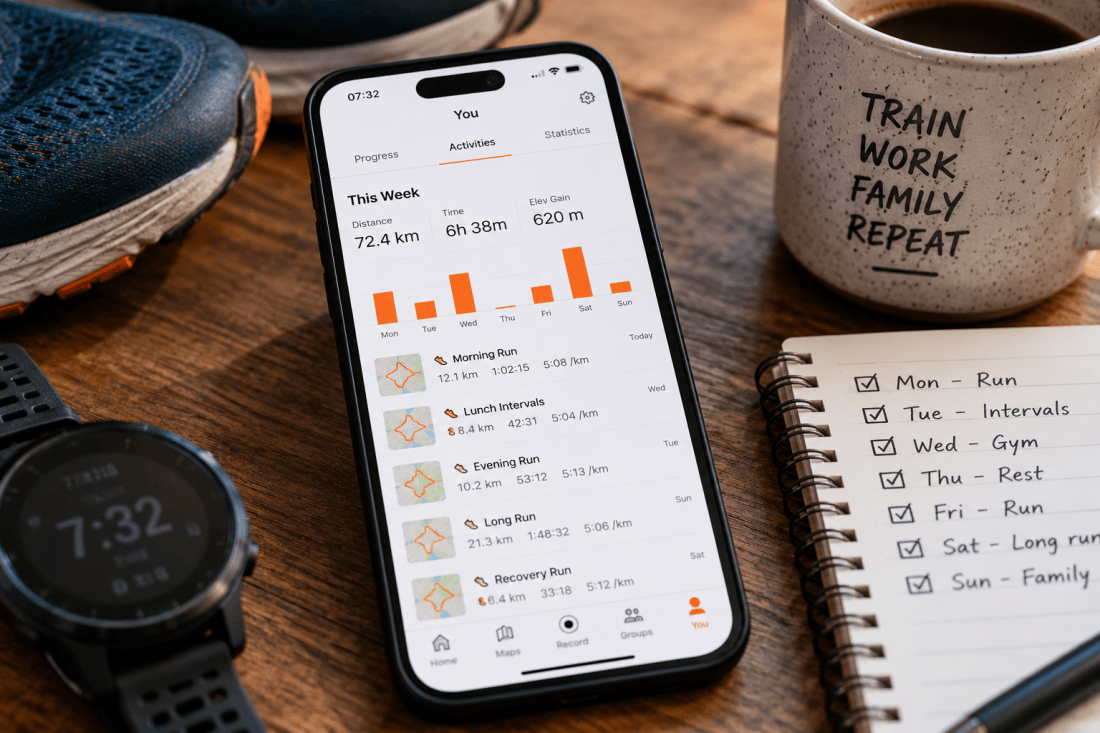
Running shoes, watch, coffee and training planner surrounding a phone displaying a weekly running workload feed.

There was a period when I thought getting fitter largely meant doing more.

I’d be up before 6am and could train hard for two hours before starting work. Coffee would get me through the morning and, despite the early start, I often wouldn’t get to bed until close to midnight.

Everything felt rushed.

Work was busy enough that getting away from my desk for a lunchtime session often seemed impossible. Three evenings a week I’d run at least 10k while my son was at football training, because it seemed an efficient way of squeezing another session into the day. On the other evenings I was usually knackered. Once I sat down on the couch, getting back off it was increasingly difficult.

I was training a lot, but I seemed to spend much of the time feeling as though I was operating somewhere close to the edge.

More recently, something has changed.

My latest marathon block actually involved less training time than the periods when I was preparing for long trail races and 70.3 triathlons. Yet I generally felt sharper and in better fettle. I had more energy for work and, importantly, more energy for the kids.

I’ve also managed to reprioritise work enough to free up some time at lunchtime. Getting a couple of sessions done during the working day has taken some of the pressure away from those early mornings. I still need to get better at going to bed earlier, but it feels as though things are moving in the right direction.

Is working harder actually making us better?

Clearly, endurance sport requires work. There probably isn’t a clever shortcut that allows us to avoid the miles, the harder sessions and the consistency required to improve.

But perhaps the important number isn’t simply how much training we can complete.

Perhaps it is how much training we can recover from and adapt to.

A two-hour session before work doesn’t exist in isolation. If it means getting up before 6am after less than six hours’ sleep, rushing into a stressful working day, relying on caffeine to stay alert and then training again that evening, the physiological cost of that session might be rather different from the same workout performed by somebody who is properly rested.

Training itself is only the stimulus. The improvement comes afterwards.

That makes me wonder whether I spent periods accumulating an impressive amount of training without necessarily giving my body enough opportunity to benefit from all of it.

There is also a wider question about what we’re actually trying to optimise.

If another five hours of training each week produces a small improvement in race performance but leaves me permanently tired, less productive at work and with less energy for my family, is that actually better performance?

I’m increasingly unconvinced that it is.

Perhaps the aim isn’t to discover the maximum amount of training I can physically squeeze into seven days. It is to find the minimum effective training required to produce the improvement I’m looking for, then make sure I can absorb it.

That doesn’t mean making training easy.

The interesting possibility is almost the opposite: by removing some of the unnecessary volume and improving recovery, perhaps I can arrive at the sessions that really matter capable of working harder.

Less training. Better training.

So what does the evidence say?

That is what I want to explore.

How much does sleep affect endurance performance and adaptation? What happens when training load is combined with significant work and family stress? Can reducing volume while protecting the important sessions actually make an amateur endurance athlete faster?

And perhaps most importantly for somebody trying to fit endurance sport into an otherwise fairly normal life:

Where is the point at which doing more stops making us better?

MAF explored: can running slower help me run faster?

AI-generated illustration of a male runner from behind on a single treadmill in a worn gym corner.

Can running slower help me run faster? With Chester behind me and roughly ten weeks before my next marathon training block, I have a useful opportunity to explore MAF training—and put myself through a small experiment.

MAF stands for Maximum Aerobic Function. Developed by Dr Phil Maffetone, the approach uses a heart-rate ceiling to keep training easy while building aerobic endurance and the capacity to use fat as fuel. The aim is to become faster at the same comfortable effort.

The familiar calculation is 180 minus your age, with adjustments for health and training history. At 49, that gives me 131 bpm before adjustments. Recent illness and interrupted training suggest a more cautious starting point of 126 bpm under Maffetone’s rules.

There is good science behind the benefits of easy endurance training. There is less certainty that this particular calculation identifies an individual’s aerobic threshold accurately. I’m treating it as a practical starting point, with an open mind about what the results will show.

My initial treadmill test is planned for Monday 19 October, provided I have recovered sufficiently from the marathon. I’ll then repeat the same test each Monday morning: the same fixed distance, the same target heart rate, and as consistent a set-up as possible, including the treadmill, incline, warm-up and cooling.

My Garmin does not accurately measure my treadmill pace, so I’ll calculate pace from the elapsed time taken to cover the fixed distance shown on the treadmill. I’ll use the watch to record heart rate, rather than letting its distance estimate decide whether I’m improving.

The question is simple: will I cover that distance more quickly at the same heart rate? I’ll also note how I feel and how well I recover. Early gains may reflect recovery from Chester and the recent illness, so I’ll look at the trend rather than celebrate every quicker test.

I’ll add the results here as the weeks unfold. Ten weeks, one willing guinea pig, and a little patience.

Further reading: Maffetone’s 180 formula and research on endurance-training adaptations.

Do we need supplements?

Generic supplements alongside a selection of whole foods

Starting from first principles: do we need supplements—for everyday life, sport or getting older?

The word suggests something extra. So what are we adding, and why? Are we filling a nutritional gap, looking for a performance benefit, or buying reassurance? Those are different questions.

Before reaching for a test, perhaps the simplest starting point is to look at what I eat and how it measures up. That won’t tell me everything, but it seems a sensible place to begin.

I recently stopped taking Vitals by Heights after trying it for a while. The scientific explanations appealed to me, and the story was convincing. Add the steady reminders about what apparently starts declining at my age, and I was an easy sell.

I haven’t noticed any difference since stopping. But I don’t feel different taking creatine either. I value its research backing—and its relatively modest price.

So “do I feel different?” isn’t enough to judge whether something works. Although it does help. Coffee remains my number one: I’ve found THE brand for me, I love it, and I can feel it.

That brings me back to Vitals. Could it have been filling gaps I hadn’t noticed? And if so, could I fill them through food instead? Given the choice, I’d rather improve my diet than add another supplement.

I’ve looked at what Vitals actually provides: the ingredients, the doses, and how they compare with recommended intakes. I’ve also explored whether being an amateur endurance athlete—or simply getting older—changes those needs.

NAD+ and NMN can wait for a separate post. One rabbit hole at a time.

My conclusion for now

For now, I haven’t found a clear nutritional reason to go back to Vitals. It supplies useful nutrients, but several B-vitamin doses are many times the daily reference intake, and a bigger number on the label does not, by itself, establish a bigger benefit.

I was reassured by the food comparison. My diet includes meat, fish, plenty of fruit and vegetables, nuts and seeds, so many of the nutrients in Vitals are likely already covered. That is a reasonable starting assumption, rather than proof: portions, frequency and absorption still matter.

I also don’t immediately assume that approaching 50 and training regularly means I need the enhanced doses in the bottle.

Vitamin D is the clearest exception to a simple “food should cover it” approach. UK guidance is to consider 10 µg daily in autumn and winter, compared with the 45 µg in Vitals. Others, like Omega-3 and iodine depend on the fish and dairy I actually eat, and I’m conscious that iron may need attention.

So my current view is that much of what Vitals offers is potentially already covered by my diet, and I can simply top up on the exceptions above*. This should be much more affordable than regular branded supplementing. *Subject to checking the absorption of the proposed supplements.

The tables and sources below show how I reached this provisional view. View the Vitals comparison or the food examples.

6 October 2026: Vitals and food sources

These tables compare the current Vitals⁺ formula with daily reference intakes and food sources. The reference is a healthy man around 50 training 8–10 hours a week. Training does not automatically raise every vitamin requirement or its safety limit; these are starting references, not individually measured needs.

Table 1: What Vitals provides

Vitals doses are for two capsules daily. Recommended intakes below use UK Reference Nutrient Intakes (RNIs), with EFSA adequate intakes marked *. These differ from the generic Nutrient Reference Values (NRVs) on supplement labels. Upper limits are safety ceilings, not intake targets.

IngredientVitals daily doseDaily reference intakeAdult upper limit¹
Vitamin A151 µg700 µg3,000 µg preformed vitamin A
B1 — thiamin30 mg1 mgNot established
B2 — riboflavin30 mg1.3 mgNot established
B3 — niacin30 mg16.5 mg niacin equivalents900 mg nicotinamide²
B5 — pantothenic acid49 mg5 mg*Not established
B68 mg1.4 mg12 mg
B7 — biotin50 µg40 µg*Not established
B9 — folate, as 5-MTHF500 µg200 µg dietary folate³1,000 µg added/supplemental folate³
B1225 µg1.5 µgNot established
Vitamin C92 mg40 mgNot established
Vitamin D345 µg / 1,800 IU10 µg / 400 IU100 µg / 4,000 IU
Vitamin E31 mg13 mg*300 mg
Iron5 mg8.7 mg40 mg safe level⁴
Zinc7.5 mg9.5 mg25 mg
Selenium55 µg75 µg255 µg
Iodine152 µg140 µg600 µg
Chromium100 µgNo EFSA requirement establishedNot established
Omega-3 — EPA + DHA375 mg: EPA 125 + DHA 250250 mg combined*No formal UL established
Blueberry/bilberry extract80 mg, including 29 mg anthocyaninsNo recommended intake establishedNot established

¹ Limits generally cover food plus supplements. “Not established” does not mean unlimited intake is safe. The vitamin A limit applies to retinol and retinyl esters; UK advice is more cautious about long-term high retinol intake, particularly as people get older.
² Vitals uses nicotinamide. Nicotinic acid has a much lower upper limit of 10 mg.
³ Natural food folate and supplemental 5-MTHF differ in bioavailability, so this is not a direct dose-for-dose comparison. The folate upper limit covers added/supplemental folate and excludes naturally occurring food folate.
⁴ Iron’s 40 mg figure is an EFSA safe level, not a formal upper limit or a recommended dose.

Table 2: Food contributions towards those intakes

These are examples of realistic portions, not a daily menu. Some meet the reference intake; others contribute alongside the rest of a varied diet. Amounts are rounded estimates and vary by food, preparation and source. Meat and fish weights are cooked, or drained for canned fish. Click a nutrient name for its food-composition source.

NutrientDaily reference intakeExample portions and approximate contribution
Vitamin A700 µgOne baked sweet potato provides ample vitamin A activity from beta-carotene; carrots and leafy greens also contribute.
B1 — thiamin1 mg150 g pork chop ≈ 0.7 mg + ½ cup cooked black beans ≈ 0.4 mg: ≈ 1.1 mg.
B2 — riboflavin1.3 mg250 ml milk ≈ 0.5 mg + two eggs ≈ 0.4 mg + 30 g almonds ≈ 0.3 mg: ≈ 1.2 mg.
B3 — niacin16.5 mg equivalents150 g grilled chicken breast ≈ 18 mg niacin, before the contribution from dietary tryptophan.
B5 — pantothenic acid5 mg*150 g chicken ≈ 2.3 mg + half an avocado ≈ 1 mg + two eggs ≈ 1.4 mg + ½ cup cooked broccoli ≈ 0.5 mg: ≈ 5.2 mg.
B61.4 mg150 g chicken ≈ 0.9 mg + one banana ≈ 0.4 mg + one cup boiled potatoes ≈ 0.4 mg: ≈ 1.7 mg.
B7 — biotin40 µg*Two cooked eggs ≈ 20 µg + 150 g canned pink salmon ≈ 9 µg: ≈ 29 µg. Other foods contribute; biotin food data are less complete.
B9 — folate200 µg½ cup cooked spinach ≈ 131 µg + four cooked asparagus spears ≈ 89 µg: ≈ 220 µg.
B121.5 µg100 g cooked Atlantic salmon ≈ 3 µg; alternatively, 250 ml milk contributes ≈ 1.3 µg.
Vitamin C40 mgOne orange ≈ 70 mg, one kiwi ≈ 64 mg, or ½ cup raw red pepper ≈ 95 mg.
Vitamin D10 µg100 g cooked sockeye salmon ≈ 17 µg. Content varies by species; occasional fish meals do not ensure adequate intake throughout the week.
Vitamin E13 mg*30 g almonds ≈ 7.2 mg + 25 g sunflower seeds ≈ 6.5 mg: ≈ 13.7 mg.
Iron8.7 mg150 g braised beef ≈ 3.5 mg + ½ cup cooked lentils ≈ 3 mg + 30 g cashews ≈ 2 mg: ≈ 8.5 mg. Absorption differs between foods.
Zinc9.5 mg150 g cooked beef ≈ 6.7 mg + 30 g pumpkin seeds ≈ 2.3 mg + 250 ml milk ≈ 1 mg: ≈ 10 mg.
Selenium75 µg100 g canned sardines ≈ 53 µg + two eggs ≈ 30 µg: ≈ 83 µg.
Iodine140 µg200 ml cow’s milk ≈ 50–100 µg + 150 g yoghurt ≈ 50–100 µg + one egg ≈ 25 µg: ≈ 125–225 µg.
Omega-3 — EPA + DHA250 mg average*One 140 g cooked Atlantic salmon portion supplies roughly 2.6–3 g: ≈ 370–430 mg/day averaged over a week.
ChromiumNo EFSA requirement establishedNo established requirement to match Vitals’ 100 µg.
AnthocyaninsNo established requirementBerries can form part of a varied diet; there is no established requirement to match the extract’s dose.

A varied diet cannot by itself confirm nutrient status. Vitamin D is a particular limitation of a food-only approach: UK guidance is to consider a 10 µg daily supplement in autumn and winter. Dietary assessment and, where appropriate, blood tests can help identify individual gaps.

Sources: Heights Vitals⁺ formula; UK government dietary recommendations; EFSA upper-limit summary (August 2025); EFSA adequate intakes for B5, biotin, vitamin E and EPA/DHA; NHS vitamin D guidance; NHS vitamin A guidance; IOC consensus on supplements and athletes. Checked 6 October 2026.